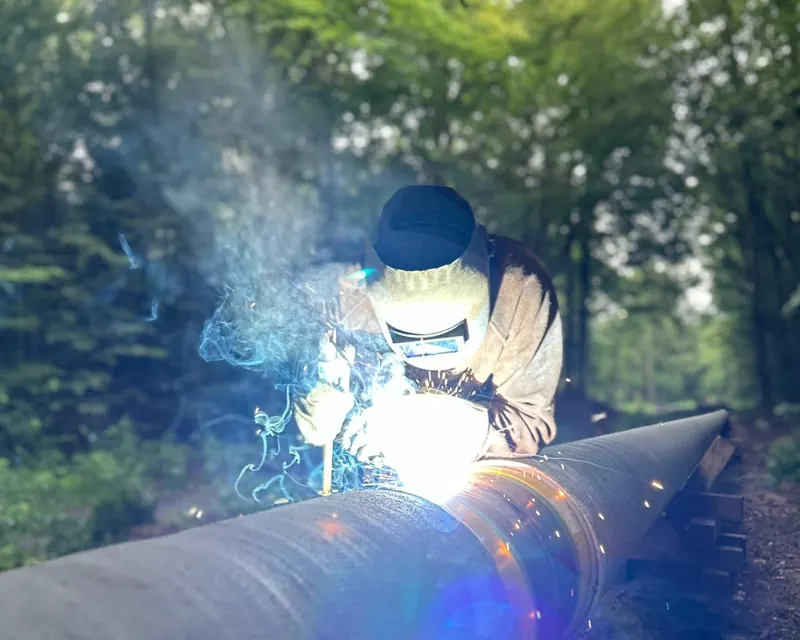
Steel pipes are everywhere in pipeline construction: in district heating networks, in gas and industrial lines or as protective pipes. Several arc welding methods are available to join them. Which one fits best depends on material, wall thickness, diameter, installation situation and the client’s requirements. The three most important methods on site are TIG, MMA and downhill welding.
TIG welding
In tungsten inert gas welding (TIG, in German WIG), the arc burns between a non-consumable tungsten electrode and the workpiece. A shielding gas – usually argon – protects the weld pool, and the filler metal is added by hand.
- Strengths: very clean, precise welds, hardly any spatter, good control of the weld pool. Especially suited to root passes and thinner walls.
- Limits: comparatively slow; the shielding gas is sensitive to wind, so a windbreak is often needed on site.
MMA welding
In manual metal arc welding (MMA, in German E-Hand), a coated stick electrode melts. The coating forms shielding gas and slag that protect the weld metal.
- Strengths: robust, insensitive to wind, usable with little equipment and suitable for many positions and materials – ideal for construction sites and repairs.
- Limits: the slag has to be removed after each pass; quality depends heavily on the welder’s experience.
Downhill welding
Downhill welding (in German Fallnahtschweißen) is a special form of MMA welding that is common in pipeline construction. On a horizontal pipe the weld runs from top to bottom, often with special, mostly cellulose-coated stick electrodes.
- Strengths: high welding speed and therefore high productivity on long sections of line.
- Limits: a demanding technique that needs a lot of practice; not suitable for every material and every requirement.
The methods at a glance
| TIG | MMA | Downhill | |
|---|---|---|---|
| Weld quality / appearance | very high | high | high |
| Speed | low | medium | high |
| Wind sensitivity | high | low | low |
| Typical use | root passes, thin walls | site work, repairs, fill and cap passes | long steel pipelines |
Often combined in practice
The methods are often combined: the root is welded with TIG, for example, and the fill and cap passes with MMA. This combines a clean, fully penetrated root with economical progress. The right combination is usually defined by the welding procedure specification and the client’s requirements.
Testing and qualification
Depending on the line and the client, welds are checked by visual inspection, non-destructive methods such as radiographic or ultrasonic testing and a pressure test of the line. For the welders themselves, testing to DIN EN ISO 9606-1 is the usual qualification for fusion welding of steel.
Steel pipe welding with WeldPipe
Our team specialises in welding steel pipes using TIG, downhill welding with stick electrodes and the MMA process. Looking for welders for your pipeline? Tell us about your project or give us a call.