Polyethylene (PE) pipes are now standard in gas and water supply, in sewage systems and in many civil engineering lines. They are light, corrosion-resistant and flexible. For a PE line to stay tight for decades, one thing matters most: the quality of the welded joints. The most important method for this is heated-tool butt welding, or PE butt welding for short.
What is PE butt welding?
In butt welding, two pipe ends with the same wall thickness are heated on a heating element until the plastic becomes soft. The heating element is then removed and the pipe ends are joined under a defined pressure. The material fuses into one homogeneous unit – without filler material and without a coupler. Done correctly, the weld is as strong as the pipe itself.
When is butt welding used?
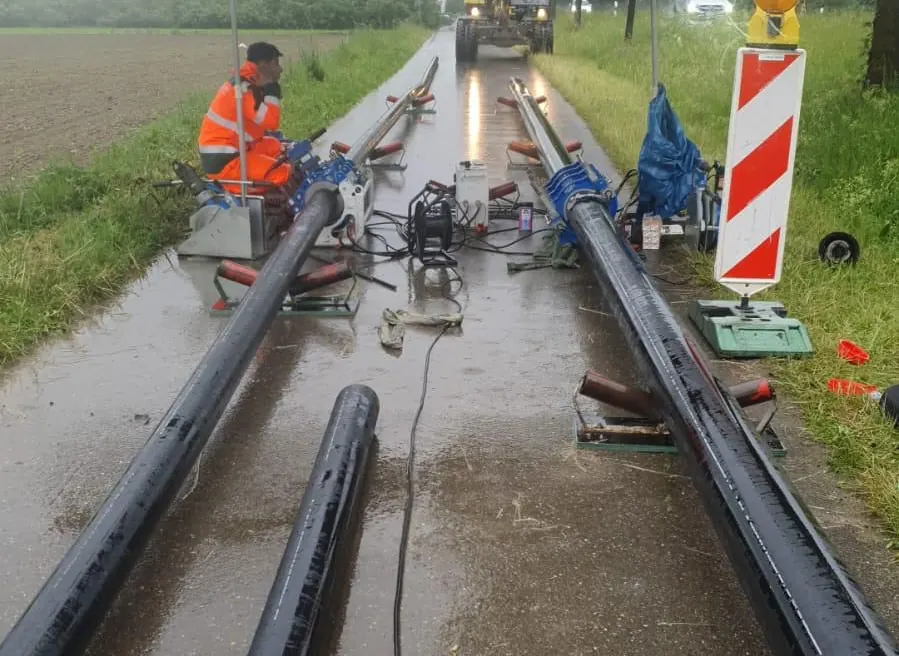
The method is particularly suited to medium and large pipe diameters and to long sections that are joined next to the trench or directly on the route. Pipes and fittings must be made of weldable, compatible material and have the same wall thickness. For small sizes, tight spaces or repairs, electrofusion with electrofusion couplers is often the better choice.
The process in six steps
- Preparation: the pipes are clamped in the welding machine and aligned. The ends are faced so they meet over their full surface. Gap and misalignment are checked, and the joint faces are kept clean and dry.
- Bead build-up: the pipe ends are pressed against the heating element until a small, even bead forms all round.
- Heat soak: the pressure is reduced sharply and the heat penetrates the pipe wall. The heating time depends on the wall thickness and is taken from the tables of the guideline or the machine and pipe manufacturer.
- Changeover: the heating element is removed and the pipe ends are brought together. This step must be as fast as possible so the joint faces do not cool down.
- Joining: the joining pressure is built up evenly, forming the typical double bead.
- Cooling: the joint cools under joining pressure and must not be moved or loaded during this time.
For PE, the heating element temperature is typically around 220 °C. The exact values for temperature, pressures and times depend on the material, pipe size and applicable rules – in Germany mainly the DVS 2207-1 guideline.
How do you recognise a good weld?
- An even double bead all round, without notches, pores or a one-sided shape.
- No unacceptable misalignment between the pipe ends.
- A complete welding record with date, pipe data, temperature, pressures, times and the welder’s name – often recorded automatically by modern machines.
- Depending on the project, additional tests such as checking the removed bead or a pressure test of the line.
Typical sources of error
Most errors do not happen in the machine but during preparation and because of site conditions: dirty or damp joint faces, wind and cold without a welding tent, long changeover times, different wall thicknesses or movement of the line while it cools. Experience and clean work on site are therefore just as important as the right technology.
Qualification and rules
In Germany there are recognised rules for welding plastic pipes, such as DVS guideline 2207-1 for execution and DVS 2212-1 for the qualification testing of plastics welders. When awarding welding work, it is worth asking for welding records and qualification certificates and agreeing the network operator’s requirements early.
PE butt welding with WeldPipe
WeldPipe Schweißtechnik from Eggenstein-Leopoldshafen near Karlsruhe carries out PE butt welding for permanent, tight connections as part of our pipeline construction services. Planning a PE line or need support on your site? Tell us about your project or get in touch.