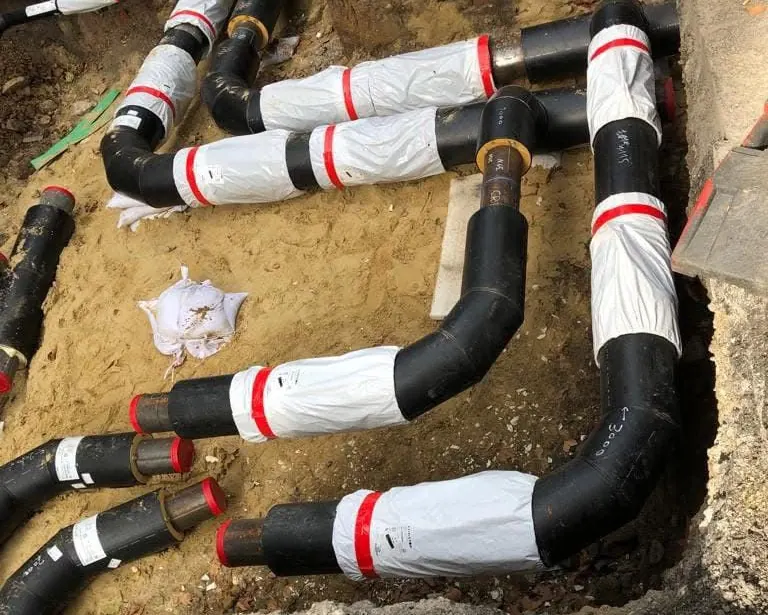
Expanding district heating is one of the big infrastructure tasks of the coming years. Most lines are built with pre-insulated bonded pipes (in German: Kunststoffmantelrohre, KMR). The pipes arrive from the factory already insulated – the weak point of every line is the joints made on site. This is where sleeve assembly decides whether the line stays tight and well insulated for decades.
How a pre-insulated pipe is built
- A service pipe made of steel that carries the hot water.
- Thermal insulation made of rigid polyurethane foam (PUR).
- A casing pipe made of polyethylene (PE) that protects the insulation from moisture and damage.
- In many systems, additional monitoring wires in the foam that later detect moisture in the insulation.
At every joint, all these layers must be restored: the steel pipe is welded, the insulation completed and the casing tightly closed.
The process at the joint
- Slide on the sleeve: before welding, the sleeve is slid onto one of the pipes – if this is forgotten, the joint has to be opened again at great effort.
- Weld and test the steel pipe: the service pipes are welded. Depending on the network operator’s requirements, visual inspection, non-destructive testing and a pressure test follow.
- Connect the monitoring system: the wires are connected and measured before the joint is closed.
- Prepare the casing: the PE surfaces are cleaned and roughened so the sleeve holds permanently.
- Fit and close the sleeve: the sleeve is centred and – depending on the system – shrunk on or welded.
- Tightness test: before foaming, the sleeve is usually tested with low air pressure and leak-detection fluid.
- Foaming: PUR foam is filled in through the openings in the sleeve and fills the cavity completely.
- Seal the openings and document: fill and vent holes are permanently closed and the work is recorded.
Which types of sleeve are there?
Depending on the pipe system and manufacturer, different sleeves are used, for example shrink sleeves that are heat-shrunk onto the casing or weld sleeves that are welded to the PE casing. The sleeve type is usually specified by the pipe system and the network operator. What matters is that assembly follows the instructions of the respective system exactly.
Typical mistakes and their consequences
- Moisture in the joint or in the foam – it reduces insulation and can cause corrosion on the steel pipe.
- Wrong foam quantity or temperature, leaving voids.
- Poorly prepared casing surfaces on which the sleeve does not stay tight.
- Damaged or unconnected monitoring wires that make later fault finding impossible.
Many of these mistakes only show after years – and then at great cost for excavation and repair.
Rules and standards
In Germany, joints on pre-insulated pipes are governed among others by the DIN EN 489 series of standards and the AGFW worksheets, supplemented by the installation instructions of the pipe and sleeve manufacturers. The requirements for your project are usually set by the network operator.
District heating work with WeldPipe
WeldPipe Schweißtechnik carries out sleeve assembly as well as insulation and foaming of district heating pipes and offers a complete district heating service – from preparation to welding. Start your project or contact us.